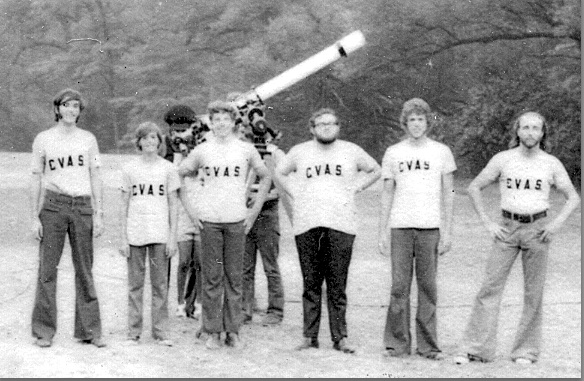
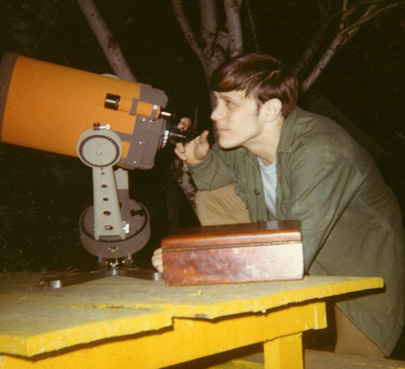
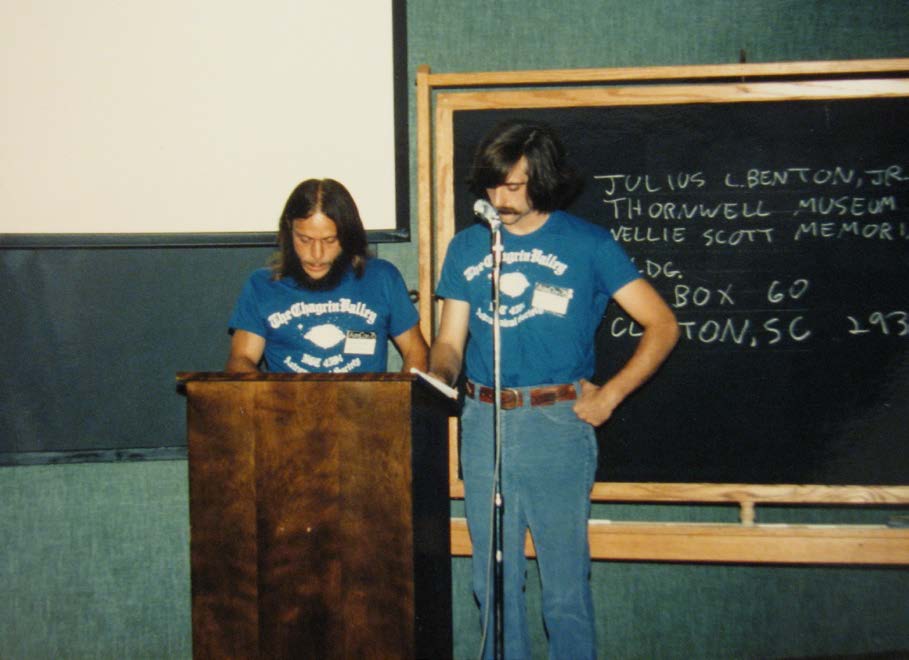
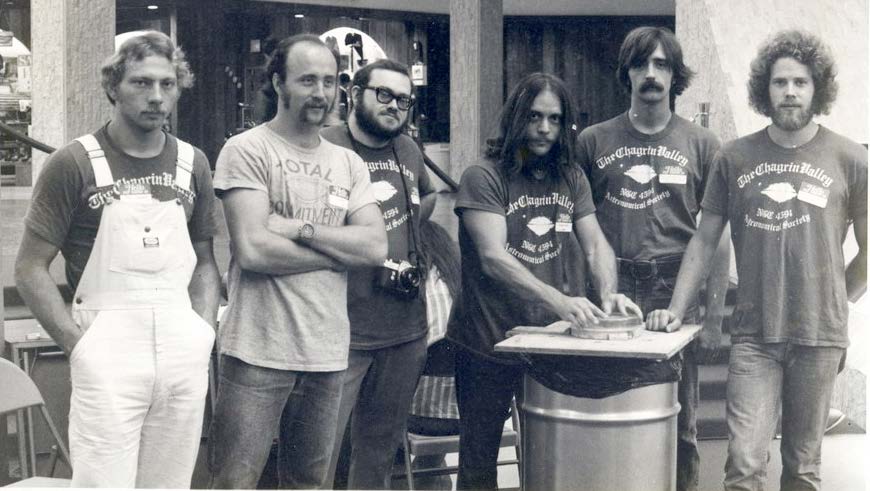
The Chagrin Valley Astronomical Society has paused to commemorate the anniversary of our founding two times in its history. In 1973 we marked our 10th year with a star party at my parents' house in Solon. Ian Cooper, Bruce Krobusek, Dan Rehner, Denny Jefferson, and Tom Quesinberry were there, along with other club members and a few guests from the neighborhood. Someone brought a large jug of dandelion wine and, as we were still a junior club back then, you can imagine the celebration! Our astronomy mentor, Larry Lovell, joked “I'm sure you guys had a party but I'm not so sure about the stars.”
By the 25th anniversary we had grown up quite a bit and realized that the CVAS had its own history, most of it good. Indian Hill Observatory was already on the map, several members held jobs in scientific and technical fields, and some of us even had children of our own. So I decided to interview the club's leaders and ask them to recall the events of our first quarter-century before that information was lost to time. In addition to those people mentioned above, co-founder George Gliba, IHO designers and builders Dan Rothstein and Doug Caprette plus several other members talked with me about the early years. Material from the recorded conversations then formed the basis for writing We Observe.
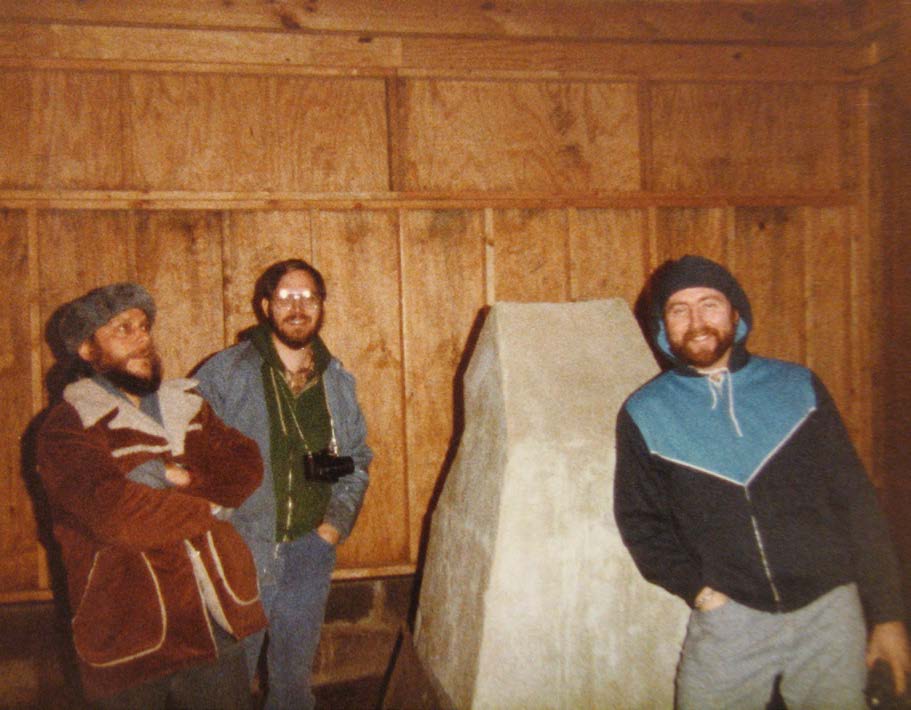
Now in our 50th year, the oldest members are passing from middle-age into geezer-age and the star parties are more about stars and less about partying. To help us remember the days of yore, Bruce has made this PDF version of the club's history complete with images taken from the CVAS web site. At my request he also added some of his own pictures from the 1970s. Many people have expressed their gratitude for We Observe over the years and I, in turn, want to thank Bruce for reissuing it. We both thank Bruce's wife, Susan, who graciously offered to proofread the text.
Together with the new version of We Observe, Bruce and I are also releasing the recorded interviews in MP3 format for the first time. There are lots of terrific memories, some told in a lively manner, by our earliest club members. I hope you will enjoy the new oral history of our club as well as the re-issue of this written version.
Last summer, as the Chagrin Valley Astronomical Society entered its twenty-fifth year, I recommended that the club set down two records of its history. The first record is a series of audio taped interviews with some of the club's most historically influential members. In order to encourage candidness, I offered each interviewee ten years of privacy before the tapes might be replayed in public. The interviews with Kim Aebi, Doug Caprette, Ian Cooper, George Gliba, Al Havrilla, Dennis Jefferson, Bruce Krobusek, Tom Quesinberry, Dan Reiner, and Dan Rothstein may be of interest to future club members during the thirty-fifth anniversary year and beyond.
The information from these interviews was crucial to the second record of the club's history, which is this text. I recall the first few years of the club's existence from my own participation. However, there have been many years between then and now when I have been out of the Cleveland area and only remained in contact by letters, telephone calls, and visits. Thus, the information in the interviews filled in long gaps.
I found the historical research for this book to be an adventure. I read as many old Valley Skywatcher articles as I could find. I played and re-played the tapes, searching for threads that tied the little club of 1963 to the larger one of 1988. I think I have succeeded in that, and I believe the book is an accurate portrayal of the process by which the club came to be what it is today.
This volume was created primarily for entertainment. However, it may also be useful as a source book or idea book. Someone who desires to improve the club or to try a new project may find a few good ideas on these pages.
The club history was written in a way that I hope will please the people who are in it. I have concentrated on the many club achievements and downplayed the mistakes. I adopted the adage that “If you can't say anything nice, don't say anything at all.” I've left out anything I considered unscrupulous. What is left is the good stuff of amateur astronomy.
Tom Quesinberry reviewed and proofread the text. Kim Aebi did the drafting.
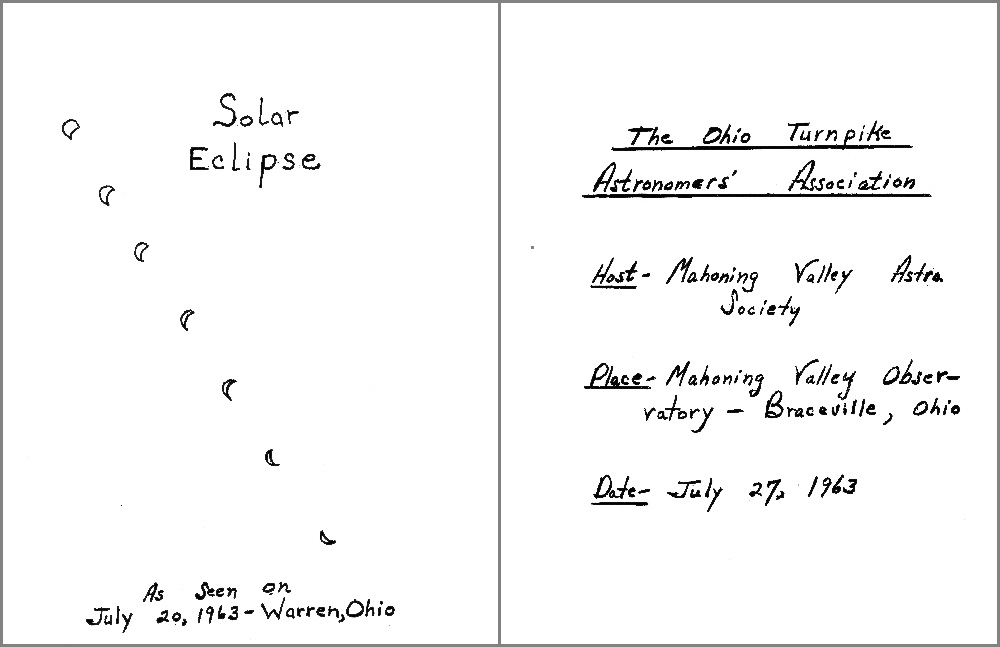
In the early 1960's, the Heavens and the Earth were filled with wonders. In February 1961, Jupiter and Saturn climaxed a beautiful conjunction by passing within about ten arc minutes of each other. In September 1962, Saturn was again at the center of attention when it was occulted by the dark limb of a ten day-old moon near the meridian. The immersion lasted over two minutes. On Saturday afternoon July 20, 1963, a long awaited solar eclipse was visible. About eighty percent of the Sun was eclipsed in the Chagrin Valley.
In our United States, a country that had never lost a war, President Eisenhower was followed into office by a charismatic young Democrat, named Kennedy, who promoted space exploration. We all cheered when a Jupiter-C rocket blasted our first satellite, Explorer I, into orbit. Manned spaceflight transformed the space age into a personal experience. From the rocket powered X-15 space plane through Project Mercury, we developed boyhood idols such as Alan Shepard and John Glenn.
No Chance Encounter
None of the events of this historic period were missed by two grade school boys, one from Chagrin Falls and one from Solon. The experiences of the early sixties shaped George Gliba and me. Our first face-to-face meeting followed several phone conversations in which we discussed our astronomical interests. We arranged to meet at my house on a certain Saturday in January 1963. Despite a heavy snowfall, George walked seven miles from his house to mine. He was numbed by the cold when he arrived but we enjoyed our visit anyway, and it was the beginning of a long friendship.
As winter gave way to summer, George and I explored the Warner and Swasey Observatory, the Cuyahoga Astronomy Club and other avenues in search of more amateur astronomers. With summer in full swing and the big solar eclipse fresh in our minds, we attended a meeting of the Ohio Turnpike Astronomers Association (OTAA), and that is where the idea for the Chagrin Valley Astronomical Society jelled.
In September 1963, we convened the first meeting of the CVAS, with a total of four members. The other members were Don Tuson and Rick Wilkins. We had little idea of what we wanted to do, but we knew that every club had a treasury, so we began collecting 25 cents per month dues.
Our club grew rapidly, at least in people if not in money. We were joined by Bill Gebhardt later that year. In 1964 we added Dennis Jefferson, Clif DeMaskey, the Sabec brothers, Mark Pribanic, and Don Henning. The year 1965 brought in Tom Quesinberry, Andy Jackson, and Billy and Marty Edwards.
Many Interests, Few Resources
As the membership grew, the variety of interests and ideas multiplied. We had meteor observers, planetary observers and deep sky specialists. We ground telescope mirrors, had fights with optical rouge, and built pipe-fitting mounts. We attended our first out-of-town convention in Buffalo, after Billy and Marty Edwards moved there. We dreamed of having a club observatory, though no one imagined one on the scale of Indian Hill. One member even proposed building a 12-foot radio-controlled rocket.
Only the simpler plans and activities succeeded though. The average age by the mid-1960's was still only about 15 years, so most of us were dependent on our parents to get a ride to meetings and star parties, and on our paper routes for money to buy telescopes. One of the first good commercial telescopes was my 4¼-inch Palomar Junior; it was soon surpassed by George's homebuilt 6-inch f/12 reflector; but young Dennis Jefferson would surpass both of us by building a high quality 8-inch.
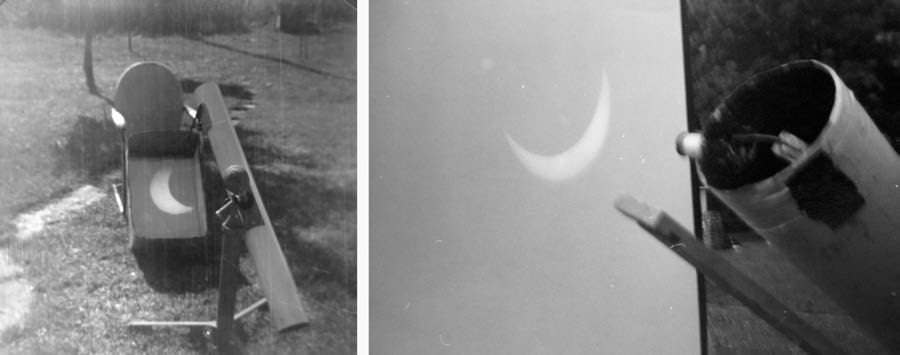
Tony Mallama (left, 4¼-inch Palomar Junior) and George Gliba (right, homemade 6-inch reflector) projecting the partial solar eclipse onto paper, July 1963.
Our first star party was at the baseball field on Portage Street in Solon. We did not have to go out in the country for dark skies in those days, as 6th magnitude stars were still visible from Solon and Chagrin. This particular date (believed to be June 14, 1964) was chosen because of the occultation of a 7th magnitude star by a 3.9 day-old moon. It may not sound like much, but to judge from our excitement you would think that we had witnessed a meteor crash to earth.
The club newsletter first appeared in September 1964, under the title Official CVAS Bulletine (sic). This was a one-page editorial marvel that was typed and re-typed with two carbons until there were enough copies for all the members. George wrote the feature article entitled “Comet Fear?” for issue number 2 in October. Then we combined on a five-page extravaganza Christmas issue, and changed the name to the Valley Skywatcher. In January 1965, Don Henning's older sister began mimeographing the Skywatcher, and it jumped to 14 pages in length.
Service and Science
The early club was interested in education as well as observation. We were well received by the local newspapers when we announced a public star party. There was one classic picture of Don and Denny in the Herald trying not to giggle at the reporter, and one article said something about “a little club with a big name.” The first of at least 11 annual star parties was held in Riverside Park in Chagrin in 1966.
In 1967, the more serious minded concentrated on club observing projects such as measuring meteor rates, and measuring the phase of Venus (Project Dicot). Two years earlier, the club neophyte observers were cutting their teeth on the long-tailed comet Ikeya-Seki, which grazed the sun and emerged as a splendid pre-dawn object.
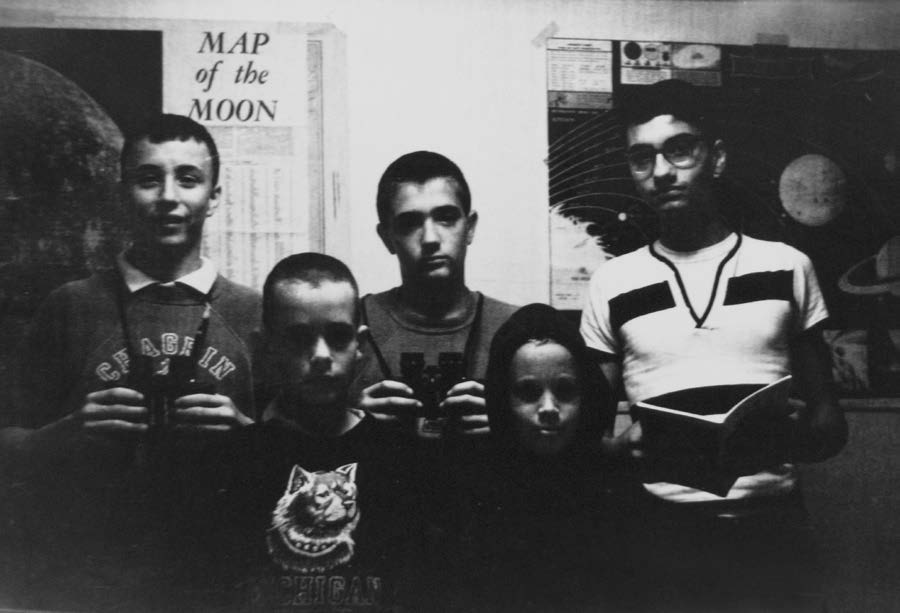
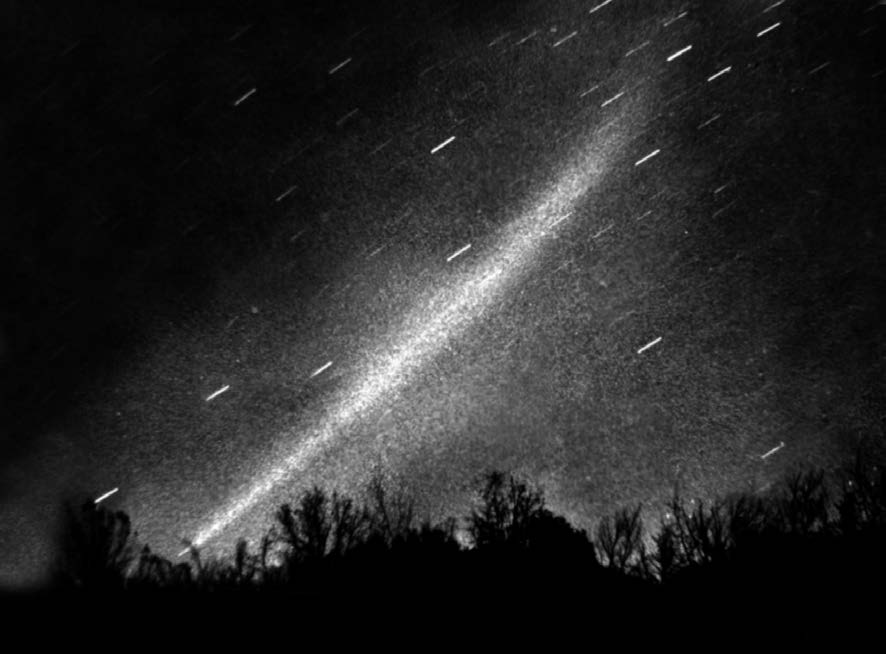
A CVAS monthly meeting at the Mallama home, 1965. Left to right: Denny Jefferson, Bill Edwards, Tom Quesinberry, Marty Edwards, Tony Mallama.Comet Ikeya-Seki, October 1965 — a long-tailed sungrazer that drew the young club to the pre-dawn sky.
The biggest observing controversy I can recall happened all the way back in 1964. On Friday evening, December 18, the moon was to be totally eclipsed, and Sky & Telescope's faithful readers were told to rate the darkness of the eclipse on the Danjon scale where L = 0 was the darkest and L = 4 was the brightest. On the morning of December 19, when we compared observing notes, all three members from Solon had gotten L = 1, while all four from Chagrin had gotten L = 2. All sorts of accusations, including collusion, faking the data, and ordinary blindness, were hurled between the two villages. The matter was not finally settled until the February issue of S&T stated that the average reported value was about 1½, which satisfied everyone.
Mr. Lovell's Observatory
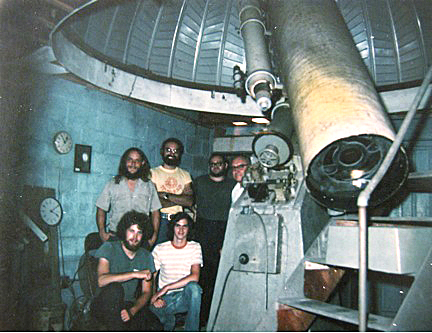
At Larry Lovell's observatory in Auburn, where several club members learned photoelectric photometry — the work that would launch the CVAS observing program.
In 1966, several of the club's main observers became involved with the photoelectric photometry program at Larry Lovell's observatory in Auburn. Thanks to the electrical engineering of Art Stokes, in Hudson, Larry was one of the first amateur astronomers in the country to observe photoelectrically. The club members refined their observing skill and data analysis practices at Larry's observatory. During the next couple of years, we observed Beta Lyrae, Algol, and other variable stars. The one that stole the show, though, was Nova Delphini, which flared up to 5th magnitude in the summer of 1967.
The slow Nova Del was still above 6th magnitude the following June when Larry and his late wife, Elizabeth, took Don, George and me to the American Association of Variable Star Observers (AAVSO) meeting in Lima, Ohio. This event was being held to honor Leslie Peltier (1900–1980) on the occasion of his 50th year of uninterrupted variable star observing — over 100,000 estimates. We met Mr. Peltier and he signed copies of his book Starlight Nights for us. Don Henning delivered a paper at this meeting on the subject of photoelectric observations of Beta Lyrae.
The Pooh Bear President
Don was an outstanding member of the early club. He was friendly, intelligent, and always willing to help. Don served two successive terms as president and the club flourished under his care. We were happy and carefree. The meetings still rotated among the members' homes, Denny delighted in humorously insulting Don as he conducted business and frequently had us all rolling on the floor with laughter. We passed our fifth year as an organization, but we were enjoying ourselves too much to stop and celebrate the occasion.
By the end of the 1960's, America had changed entirely. On one hand, it had climaxed its space program with the manned Apollo expeditions to the Moon. But on the other hand, it had reached an all time low in the black ghettos of the States and in the rice paddies of Vietnam. The greatness of Apollo was blemished for those of us who followed it. The view of the Moon was superb, but the view of the Earth was dismal. While our astronauts were exploring the Sea of Tranquility, our cities erupted in blazing and deadly race riots. While our scientists explored Hadley Rille, our soldiers were dying by the tens of thousands in a war that no one wanted.
Away From Home
George Gliba was away in the Air Force, and I was away at Vanderbilt University by 1970. Scarcely any of the other early members were active in the club. Looking back, we were lucky that the Riverside Park star parties and other club activities had brought in several new members including Bruce Krobusek, Dan Rothstein, John Schlessman, Rich Matyi, Ian Cooper, and Bruce Kermode.
The Orange Shift
Krobusek and the rest were part of the gradual shift of the membership away from Solon and Chagrin to Bainbridge and Orange. During this period, the club established relations with the Orange school system, and there was some talk of building an observatory in conjunction with Orange.
It is hard to see why the club slumped so badly at about this time. Krobusek followed Schlessman as president, serving during 1972 and cannot account for the poor showing, but he remembers it well. There were meetings with only two members in attendance, and, as a rule, most of the elected officers would not show up at all. Perhaps it was the disarray of society: the after-shock of the riots, the intense pain of the war. Perhaps it was due to poor public relations. No one can really say.
Still Some Fun
The club appeared small and fragile at this time; however, no one ever considered dissolving it. As long as there were at least two members who enjoyed astronomy, it seemed worthwhile to go on. And the members did enjoy astronomy. The meetings seemed to please those who attended, last-minute backyard star parties were popular, and there were field trips to OTAA functions such as the ones at Hiram and Hudson. Trips to Lovell's observatory and the Nassau station near Chardon occurred during these years.
There were also memorable stories such as the “infamous lawn-chair incident”, the kind of story where you had to be there to really appreciate it. The way I hear it from Bruce Krobusek, this was the night of May 16, 1971. John, Ian and Rich had gathered at Bruce's house to observe an occultation of Mars by the Moon. Bruce's parents had the old fashioned lawn-chairs, which were wooden. When Ian sat down in one, he went right through the bottom of it. A short while later, when John sat down in another one, it collapsed. The night was clear though and shortly before morning twilight the tired but happy members observed the rare occultation.
Lingering Pain
The club recovered from its low period, yet the legacy of the Vietnam era would continue to haunt us in unexpected ways for many years. In the mid-1970's, a leading club member who had fought in Vietnam ended his own life. It was symptomatic of the times.
The experiences gained from meteor observing, photometry at Larry Lovell's observatory, and visual estimates of Nova Delphini prepared the club for its major foray into the world of serious scientific research. Even during the low period around 1970, the potential was developing, as Bruce Krobusek and new member Chris Stephan were finding their way around the night sky.
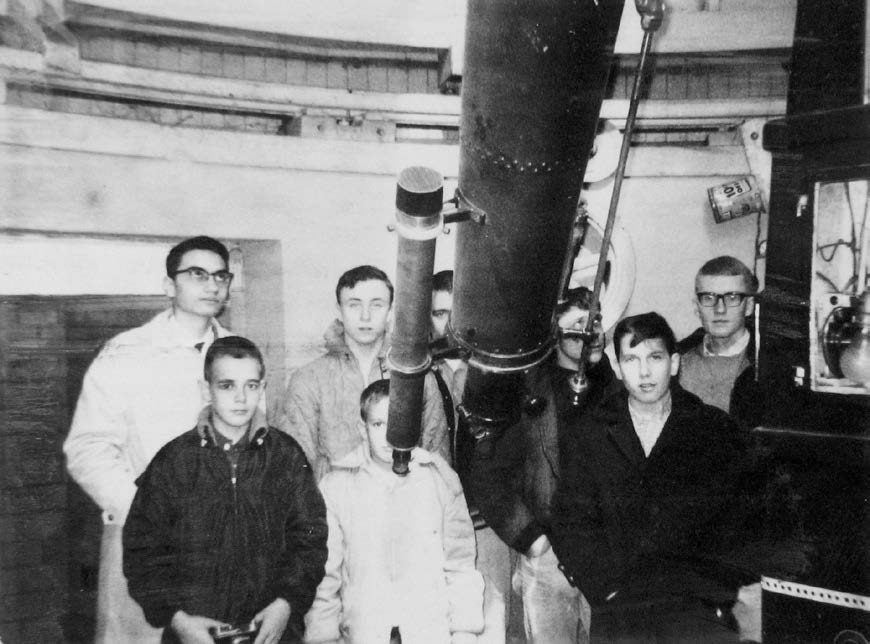
Club members at Larry Lovell's observatory — the training ground for the variable-star and binary-eclipse work the club would publish in the 1970s.
Dr. Hall
A little-known influence on the club was a young college professor on the staff of Dyer Observatory at Vanderbilt University in Nashville. Dr. Douglas Hall was special because of his involvement with amateurs. I'm not sure whether I was the cause or the effect of this interaction, but I am sure that he has since then become one of the most important professionals who involves amateurs in his research on a regular basis.
Dr. Hall's specialty was variable stars, eclipsing binaries in particular. His technique was photometry, a field ideally suited to amateurs because it is not too costly. One of the first stars that I helped Doug with during my student days at Vanderbilt was BS Scuti, a 10th magnitude eclipser in the same field as M-11. Not only was it a treat to observe at the telescope, but some of the other data we were using was made visually! I could hardly believe it, here we were preparing an article for a professional journal, and we were basing part of it on visual observations made by a group of Swiss amateurs who were timing the eclipses of this star with small telescopes and their eyes.
In science you do not pick and choose your data, you use ALL the available data that is good. In the field of astronomy where there are many more stars than there are scientists, amateurs with or without photometers are providing good data.
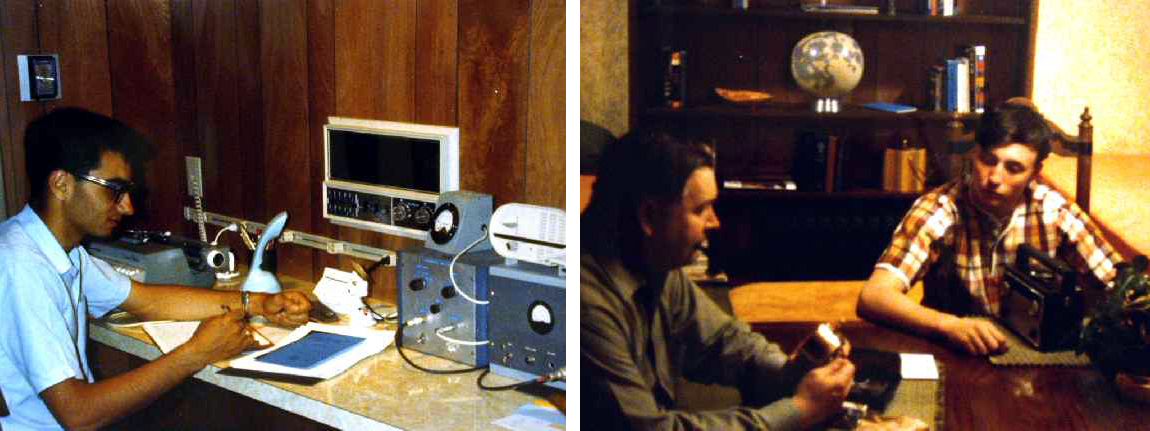
In the warm-up room at Lovell's: Tony Mallama reads the photometer amplifier voltmeter.Denny Jefferson tunes a shortwave receiver to WWV for precise timing during a photometry run.
The Start of Something Big
When I was elected Director of Observations for 1973, I was already making visual observations of eclipsing binaries on my own. It only remained to impart that knowledge and enthusiasm to a few others in the club and we were on our way to an observing dynasty. My method was to provide personal or group instruction in variable star observing to anyone who would listen. Some of the members took right to it, and others did not. The fastest learners were Bruce and Chris. Both were already avid observers when I met them and needed only a gentle shove in the right direction. In fact, within just a few years both of them were publishing their own observations in professional journals.
Comet Kohoutek
The news media made Comet Kohoutek into a front-page story because it was predicted to be bright enough to be seen in broad daylight. It did not live up to its expectations, but it did provide another object for eager club observers to focus on.
By late in 1973, I was a graduate student at Toledo University. I met Dr. Armand Delsemme, an internationally known comet expert, and had an experience that was almost a repeat of the one with Dr. Hall. As Director, I made charts of the path of Comet Kohoutek, which included stars with known magnitudes plotted alongside. The variable star observers were thus able to find the comet in their telescopes, throw it out of focus and compare it to the stars in order to make brightness estimates.
More Power
Bigger telescopes were also a factor at this time. We were no longer little boys who were impressed by 6-inch 'scopes. I rebuilt Don Henning's original 10-inch in 1971 making it the biggest telescope in the club. George Gliba came home from the Air Force in 1973 with a brand new Celestron 8, our most sophisticated instrument. Soon afterward, Denny Jefferson built the club's largest instrument, for the second time. This time it was a 12½-inch. Shortly thereafter, Chris Stephan built a 14-inch RFT.
Observer's Round-Up and Calendar
Another factor that aided in club observing was the regular reporting of results in the Valley Skywatcher, which was published religiously every second month in those days. There was a friendly rivalry among observers, and you could follow the races between Krobusek, Stephan, Gliba, Mallama, Rehner, Jefferson, Szeczak, Yanulaitus, Quesinberry, Mallion and others to see who could report the most variable estimates or planetary drawings.
Year
AAVSO Estimates
Binary Minima
Meteor Hours
Planetary Drawings
1973
601
81
14:30
25
1974
776
59
32:29
30
1975
223
58
28:48
19
1976
239
85
2:19
35
1977
58
8
15:00
71
1979
134
0
11:14
13
More Spectaculars
Club members were primed for observing by the mid-1970's, and were treated to three of the finest sights of the past several decades: Nova Cygni 1975 (peaking at magnitude 1.9, the brightest nova in 33 years); Comet West in March 1976 with a first magnitude head and 25–30 degree tails; and the supernova in M-100 on April 18, 1979, one of the brightest supernovae in recent years.
A 1972 Riverside Park star party. Left to right: Bruce Krobusek, Dan Rothstein, Tom Quesinberry, Dan Bohlander, Ian Cooper, Denny Jefferson.
Chartmaker
As the main observers of the 1970's moved on to other locales and other interests, the observing dynasty waned. A leader emerged briefly in 1982 when Randy Phelps became Director of Observations. Randy made some excellent star charts for observing variables. However the momentum had already been lost and no one took up his call to observe. A great era in the club history had ended.
George Gliba and Tom Quesinberry — two of the prime movers of the mid-1970s public-awareness push.
During the mid 1970's, the explosive growth in observing was paralleled by extraordinary civic involvement. A large number of members participated in these activities, which included public star parties, slide shows, public awareness campaigns, television and radio appearances, and formal classroom instruction. Most of this outpouring of public interest occurred from 1974 through 1978 during the presidencies of George Gliba, Chris Stephan, Tom Quesinberry and Dan Rothstein.
The best historical document concerning this period was written by Tom and George for a talk at the national Astronomical League convention in 1976. Excerpts follow:
The Bumper Stickers
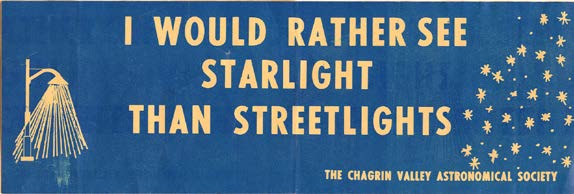
The 1974 dark-pollution-awareness bumper sticker. The club printed thousands and handed them out at OTAA meetings, lectures, and public star parties.
“Our dark pollution awareness campaign had started during the spring of 1974, when we decided to do something to combat dark pollution. After much discussion, we decided to have anti-dark pollution bumper stickers printed. The slogan ‘I would rather see starlight than streetlights’ was adopted. Our first 1,000 bumper stickers were ordered from Mars Printing Company during early summer of that year.”
“Pledges and donations paid for the first batch, which cost about a hundred dollars. They were given out free first, to CVAS members; then at the annual OTAA meeting, at Warner and Swasey Observatory lectures, to the 9th grade earth science class at Kenston High School, at CVAS Public Star Parties, and to friends and associates. The first supply of bumper stickers was exhausted in a mere three months. We're now at the end of our third batch of a thousand and ready to order our 4,000th dark pollution sticker. We see no time in the future we'll stop our campaign unless the majority of society realizes the value of the natural nighttime environment.”
Star Parties & Lectures
The first public awareness event was a star party on the night of the November 1975 Total Lunar Eclipse at the 100-acre Woodside Farm. About two dozen people attended; five telescopes were set up. The first Public Awareness lecture was at Mrs. Lois Place's fifth grade class at Lewis Sands School in December 1975. About 50 students and parents attended; seven members brought six telescopes.
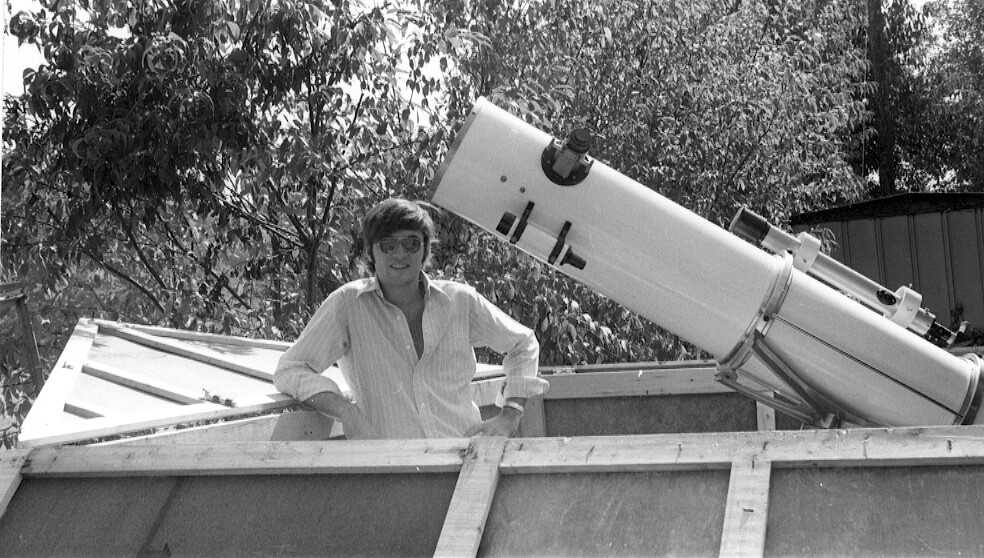
The kind of homemade instrument paraded at the public star parties — built and tuned by Art Stokes and others, then carried out to schools and parks for outreach nights.
In November 1975, the public relations committee contacted Cuyahoga Community College about teaching a non-credit class on astronomy. The first six-week session, designed by George and Tom, was taught by a different club member each week — covering history of astronomy, planets, galaxies, telescopes, optics, observatories, variable stars, and constellations. The club was paid $15 an hour, and Tri-C invited us back for the next quarter.
George Gliba and Tom Quesinberry teaching the Cuyahoga Community College astronomy class they organized in 1975.
A Window Display
In January 1978, the club assembled a window display at the Fireside Book Store in Chagrin Falls — bulletin boards with CVAS membership cards, AAVSO membership, planetary drawings, astronomical photos, bound Skalnaté-Pleso charts, telescope objectives and mirrors, Patrick Moore books, eyepieces, red flashlights, and bumper stickers. The display traveled to the Kent State Student Union and Lakeland Community College for further weeks.
“Our club, by making speakers available to the public, and by sponsoring our own events, has reached thousands of people in our area in only seven months. Won't you join us in our fight to help save the night? We are sure that folks would rather see starlight than streetlights!”
Similar public activities were sponsored by the club before and after the Public Awareness Campaign. However, the campaign represents a high-water mark, brought about largely through the efforts of Tom Quesinberry, George Gliba, and the support of Dan Rothstein and other members.
A gathering at the Indian Hill Observatory 16-inch Newtonian — the club's flagship instrument, donated by Art Stokes and re-aluminized at NASA.
The public awareness efforts of the mid 1970's led to the project to build Indian Hill Observatory. As secretary during those years, Bob Petti recorded progress on the Hill in detailed Valley Skywatcher articles. The dedication of Indian Hill Observatory on September 10, 1983 — at the OTAA convention hosted by CVAS — showed all interested that years of promises, planning and effort paid off in the long run.
1978 — Beginnings
It all began in May 1978 at a local Camp Burton star party where dreams were discussed and a surprise offer of acreage for lease was proposed by Mr. Keith Richards. In August and September 1978, an amendment to the club constitution created the office of Observatory Director, to which Tony Mallama was elected, with Ian Cooper assisting.
That August at the Mahoning Valley OTAA convention, CVAS failed in its final bidding on a Draper 6-inch f/15 refractor planned for the first observatory instrument. This led to the purchase of Mr. Stokes' homemade 16-inch Newtonian, previously used in photometric applications — another rare opportunity. By year's end, clearing the woods for a driveway and parking lot was the first order of business; the driveway, once part of a cliff, was formed with earthmoving equipment, the first large expense paid for by generous donations.
1979 — The Mirror
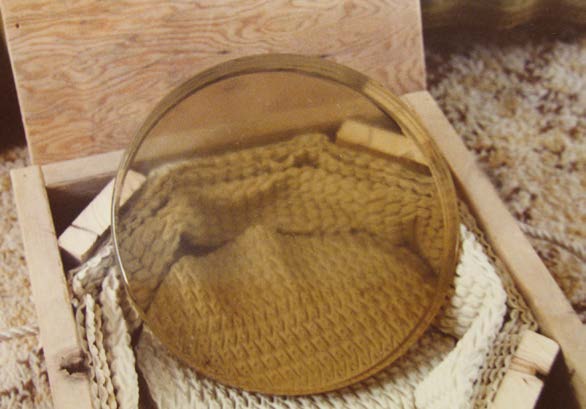
The 16-inch mounting and mirror cell underwent repair, cleaning and sandblasting. The mirror was sent to Tony Mallama in Maryland for inspection and re-aluminizing at NASA. Monthly work sessions at the site were now commonplace. First observations with portable telescopes were made. Geauga County approved the ecosystem for building. A retaining wall consisting of discarded rock debris was built surrounding the hilltop to prevent soil runoff. A building permit was acquired from the county.
1980–1982 — The Pier and the Building
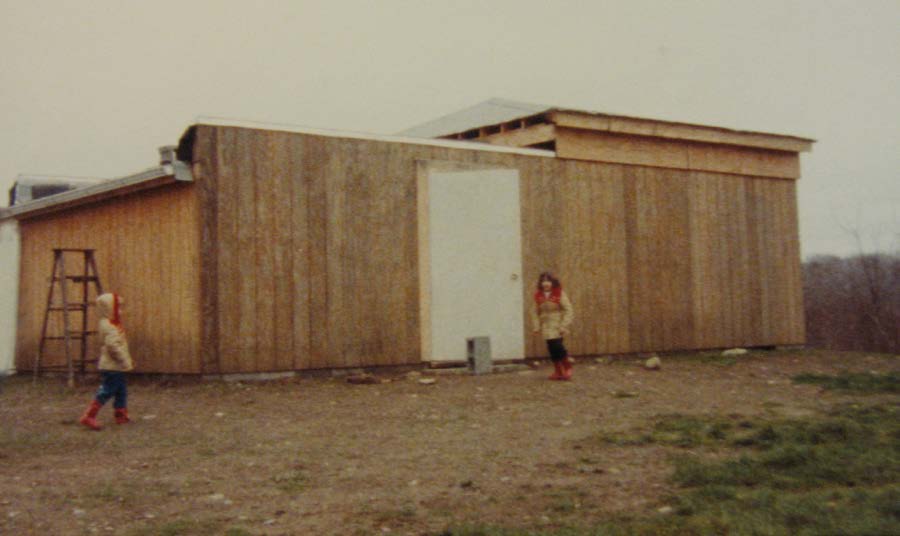
Site work at Indian Hill in 1980. The roll-off-roof building rose around the equatorial pier after the trench foundation was poured by Harold Adams.
Under the direction of Director Doug Caprette, the building dimensions were decided, and the cement pier was planned (designed after Stokes' original) and laid in August. The pier was built in two stages, with a 3 × 3 × 3 foot block totally underground and the visible pier on top — the entire 6,000-pound structure carried up Indian Hill by hand.
The Indian Hill pier under construction — a 6,000-pound concrete column carried up the hill by hand and set in two stages.
The trench foundation was dug by Harold Adams. Cement was delivered for the footer. It was a hot day, over 90 degrees, and humid. The cement truck driver suggested mixing extra water with the cement so that it would flow better. The problem, which we didn't realize at that time, was that it also caused the cement to harden faster. Dan Rothstein, Bob Petti and Doug tried to level it by pushing it along with shovels. They were working like crazy trying to get the cement leveled before it set. Bob was leaned up against a tree recovering from heat exhaustion. They got it pretty level before it set up.
Ian's carpenter friend, Bernie, came out the day they put up the frame walls. The long wall with no doorways was so heavy that it took all 12 of the people working on the Hill that day to lift it into place. The next weekend they put up the angle-iron rails for the roll-off roof. Ed Winslow had been working with them throughout all the carpentry. Without Ed they would probably never have gotten the building finished. He knew the right way to do everything, including roofing and flashing. The building is a lot sounder than it would have been without him.
1983 — First Light and Dedication
Not long before the dedication, they were ready to mount the equatorial head on the pier. The telescope tube, painted by Earl Paulin, was bolted to its saddle on the ground and several people picked it up to put it on the equatorial head. The telescope was finished, except for the mirror, the week before the dedication.
During that week, Bob Petti, Denny Jefferson, Dave Radcliff, and Doug put the mirror in its cell and the cell in the tube. That night was clear and Bob, Dave and Doug decided to get ‘first light’. It took all three of them because the telescope was not well balanced — one held the counterweight, the second held the mirror end of the tube, and the third stacked up cement blocks to reach the eyepiece. They looked at Jupiter first, then M-11, then M-22.
The night of the dedication was incredible — late September with a warm, steady breeze. T-shirt weather. Just about everybody in the club was there. A whole assembly of people gathered on the lawn for the dedication speeches. Of course, Art Stokes was there. They had a wonderful star party that night.
NASA's Goddard Space Flight Center in suburban Maryland — by 1988, six CVAS members had put in a combined 32 years of work supporting NASA missions there.
The club has been a major influence in the lives of many of us. An important change in my own life happened when Larry Lovell encouraged me to study astronomy in college. I did so and later went on to obtain a Master's degree. My degrees enabled me to get my foot in the door with a NASA contractor in 1975. By 1988, six of us had put in a total of 32 man-years of work supporting NASA at Goddard Space Flight Center: Tony Mallama (atmospheric science, then ultraviolet stellar fluxes for IUE, then the Space Telescope Guide Star Catalog, then VLBI radio astronomy); Tom Quesinberry (IUE photographic darkroom, then Landsat, then ST); George Gliba (IUE finder charts, Landsat, ST); Ian Cooper (Landsat, ST); Dan Rehner (Space Telescope Science Institute, working on the 20-million-star Guide Star Catalog); and Doug Caprette (VLBI, mechanical engineering for radio antenna flexure studies).
The International Ultraviolet Explorer (IUE) — one of the missions CVAS members supported at Goddard, contributing to stellar-flux measurements, finder charts, and darkroom work.
Our experiences at GSFC have been good for most of us. We have been able to participate in the activities that we dreamed about when we were kids, and we are doing something that we believe in for a living.
Out on the road — the club's NASA work and travel circuit took members across the country for conventions, eclipses, and observing trips.
If you learn nothing else from astronomy, you should learn that your hometown is not the center of the Universe. Meetings with other first-rate amateur and professional astronomers seldom occur in your hometown, total solar eclipses seldom pass over your house, and, of course, Halley's Comet was best seen in the southern hemisphere.
Buffalo, 1967
Our first out of state trip was to an Astronomical League convention in Buffalo. We were so young we had to get a ride from Don Henning's older sister. The most important result of this trip was that one of the League officers gave Tom Quesinberry a “model” constitution, which would serve as the basis for the club's constitution.
North Carolina, 1970
I can tell you from experience that your first total solar eclipse is like your first love — you'll never forget it. As totality approached, wild birds disappeared from the sky, and chickens at a nearby farm roosted. When darkness fell, Mercury, Venus and the brighter stars of Orion appeared in the sky. The pearly-white solar corona dazzled our amazed eyes for a few precious, awe-struck minutes.
Winnipeg, 1979
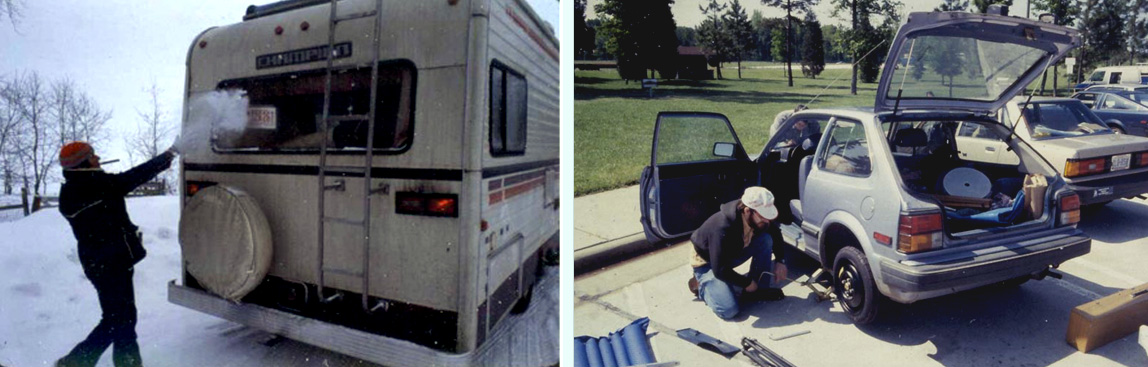
The first successful total solar eclipse expedition by a group from the club was in Winnipeg, Manitoba in the dead of winter. Most of the members, including Keith Richards, Dan Rothstein, Doug Caprette, and Steve Fishman drove up in a rented motor home. They had to bear sub-freezing temperatures along the way because the propane heater in their mobile home froze. On reaching Manitoba, they were treated to a spectacular auroral display on the night before the eclipse with streamers stretching from the north horizon all the way to the south.
The Carolinas, 1984
Another east coast eclipse passed through the Carolinas in 1984 — so near the boundary between total and annular that authorities were debating exactly what observers would see. Dan Rothstein, Doug Caprette, Steve Fishman, Bob Modic, Bob Petti and Al Havrilla chased it. Camped out the night before on the Virginia–North Carolina border, they had problems with heavy rain and collapsing tents. A missed left turn split the group into two; Doug's car had a flat tire driving 80 mph toward the centerline. He and Steve dumped out all the equipment from the trunk, changed the tire, and loaded back up in record time. The eclipse started while they were still driving, but they reached the centerline and set up in time to watch totality.
Stellafane
On Breezy Hill, in Vermont, there is a telescope convention every summer that is the Mecca for Amateur Telescope Makers (ATMs). When you see the picturesque clubhouse with the inscription “The Heavens Declare the Glory of God” in bold letters across the eaves, you get religion. In 1983, Denny Jefferson made his first trip to Stellafane along with Doug Caprette, bringing a 6-inch f/8 mirror he had figured and mounted in a Newtonian configuration. He didn't believe he had a chance to win — but Walter Scott Houston and Dennis di Cicco called him to the clubhouse: first place had gone to a refractor, second to an 18-inch, and third to Denny's 6-inch f/8.
Halley's Comet, 1985–86
The 1985–86 apparition of Halley's Comet was the worst in 2000 years, yet we had all been waiting for it since the time we first saw its name in our grade school science books. The big trip was a three-week excursion at the end of March 1986 by Al Havrilla, Steve Fishman, Bob Modic, and Dan Rothstein — the Very Large Array, Lowell Observatory, the U.S. Naval Observatory, the Grand Canyon, Kitt Peak, McDonald Observatory, and a week at Big Bend National Park. The Texas sky was so dark that the Milky Way cast a shadow on the ground. To climax the great observing session, they witnessed a magnitude-9 bolide. At first it looked like a flare going up, started out white, turned green, and exploded as it went down, lighting up the entire landscape. Al says he was unable to speak for five minutes.
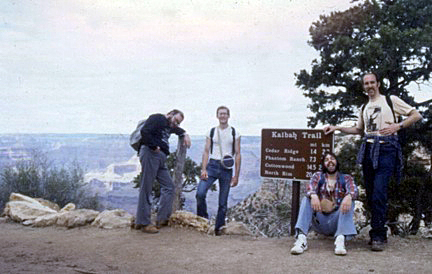
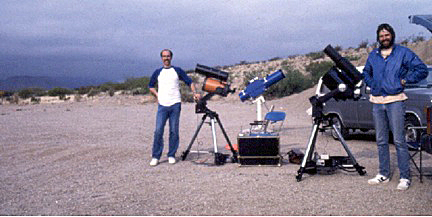
On the road during the 1986 Halley's Comet expedition — three weeks across the American Southwest, stopping at every major observatory along the way.A daytime break from observing — somewhere between the Grand Canyon and Big Bend, March 1986.Steve Fishman and Al Havrilla on the big expedition out west — under skies dark enough that the Milky Way cast a shadow on the ground.↑ back to top
What Now? (written 1988)
The club is in its twenty-fifth year. In September, we will hold our 300th consecutive monthly meeting. We have a fine observatory, we have provided education to the community, and we have contributed significantly to basic astronomical research. Now is an opportune time to observe the club as it is today, and to look toward the future.
Our principal members all agree that we should be doing more in the community. We have a responsibility to educate and share the wonders of astronomy with the public. Whether this means teaching more classes, having more window displays, having public star parties at Riverside Park again, or running buses from the inner city out to Indian Hill, it has to be done. If you are not growing, you are dying.
Ninety-Nine Years
This story has been about men and the stars. It began with little boys and little telescopes, and developed into a beautiful extended family of men and women. This family has worked, played, laughed, and cried together. We have made horrible mistakes, and celebrated great achievements. We have cared for and helped one another. Together, we have appreciated and loved the stars.
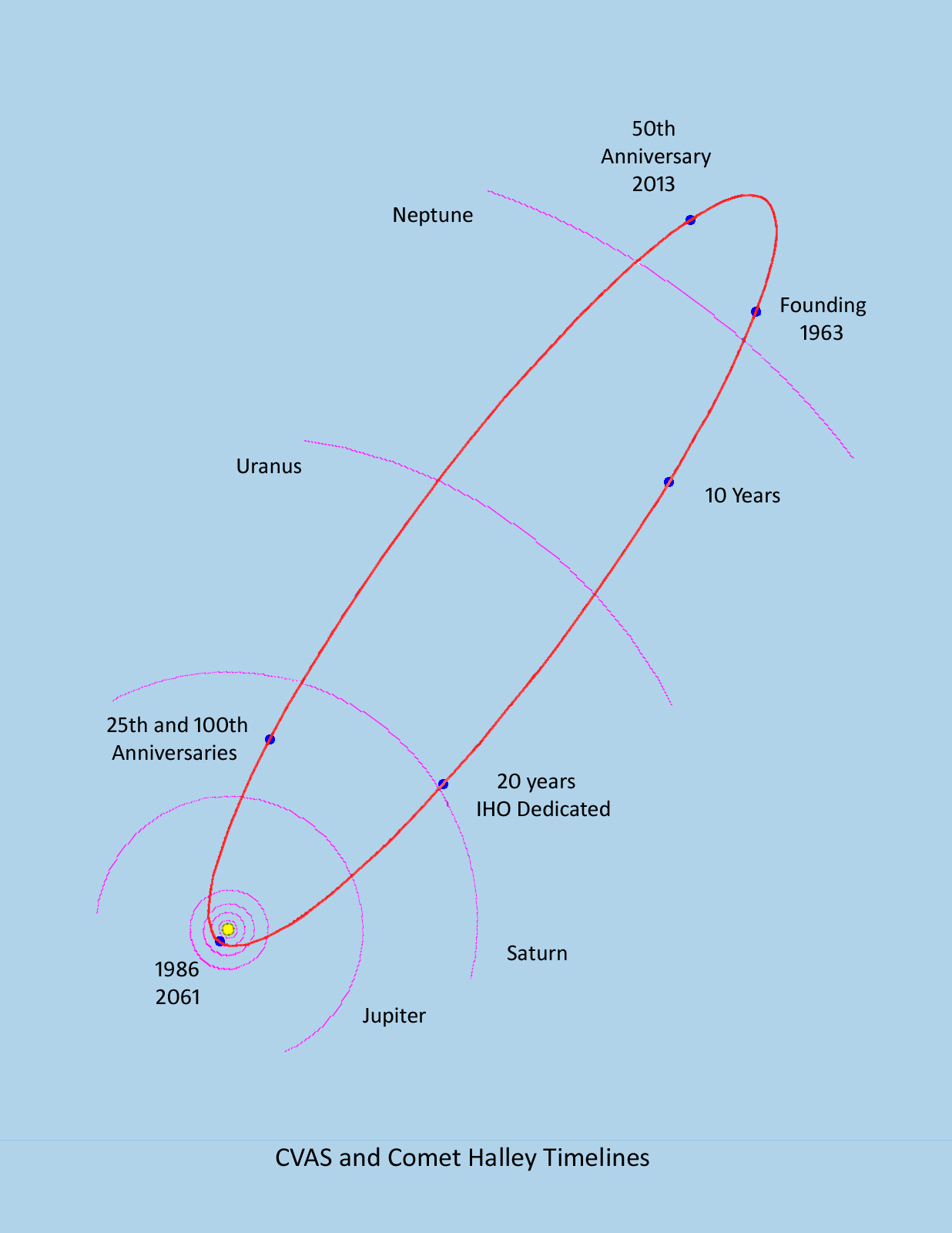
The club's co-founder, George Gliba, recently reminded me that we will still have the lease for Indian Hill when Halley's Comet returns again in 2061. We won't be there to see it, of course, but maybe some of our children and grandchildren will be. Indeed, our lease on Indian Hill lasts for ninety-nine years. Our principal members believe the Society will live for ages to come.
‘What Now?’ was the final chapter in the first edition of We Observe and it summarized the key aspirations of the Chagrin Valley Astronomical Society as expressed by leading club members 25 years ago. Looking back on the period from 1988 until the present it is gratifying to see how many of these goals were actually achieved.
The issue of observatory maintenance which was so divisive during the 25th anniversary year was successfully addressed and the facility has flourished. Indian Hill is not just one Observatory anymore but a complex of several domed and roll-off roof structures each hosting unique instrumentation. The club is even now undertaking construction of a deck and shelter for an 18-inch reflector donated by Ian Cooper. The current Observatory Director, Ken Fisher, has done a very able job with help from Tom Puklavec, Mike Prochaska, Marty Mullet, Russ Swaney and others. The late Marty Niemi was an extremely skilled contributor to a host of IHO projects over many years and the club has established a memorial fund in his honor. To this Ian adds, “Indian Hill would not be the facility it is today without Marty. In addition, how many astronomy clubs OWN, free and clear, the land on which their observatory sits? It's CVAS and <expletive deleted> debris!”
The 16-inch Stokes telescope has been used to great advantage for astronomical research. In 2007 one of the first ever eclipses of a satellite of Uranus was recorded with a CCD camera and became the subject of an important research article in the professional journal Icarus. The 12-inch telescope is now being used extensively to measure the positions and magnitudes of asteroids, and to time eclipses of the satellites of Jupiter. These data are used by NASA/JPL and the astronomical community at large. Bob Modic made the historic Uranus observation; Ron Baker observes asteroids and Galilean satellites. Bruce Krobusek also contributes to the satellite eclipse program from his home in upstate New York.
In its 30th anniversary year the CVAS could finally boast a PhD astronomer. Randy Phelps, who was the club's Director of Observations and attended Case Western Reserve University in the 1980s, attained his doctoral degree in Astronomy and Physics from Boston University in 1993. His post-doctoral research involved using the Hubble Space Telescope in the Extragalactic Distance Scale Project. Dr. Phelps has served as a program director for the National Science Foundation and became a full professor of Physics and Astronomy at California State University.
No achievement looms larger during the club's second quarter century than its partnership with the Geauga Park District. The CVAS has played an important part in the development of Observatory Park in Montville Township, which includes the 25-inch Oberle telescope. In addition to star gazing with the mammoth reflector, park naturalists offer weekly planetarium programs at the Robert McCullough Science Center. Tom Quesinberry played a major role in the Park District receiving its International Dark Sky Association Silver Tier status. George Gliba donated a museum-quality meteorite collection to the CVAS and the club, in turn, donated it to the park.
There is no doubt that a great many more achievements could be recounted, fascinating stories told and memories revived. The second 25 years of the Chagrin Valley Astronomical Society must have been just as vivid for those who lived them as were the first 25 to the early members. A sequel to We Observe would be most appropriate and welcomed, but that is a history for someone else to write. Any volunteers?
We Observe · 50th Anniversary Edition (June 2013).
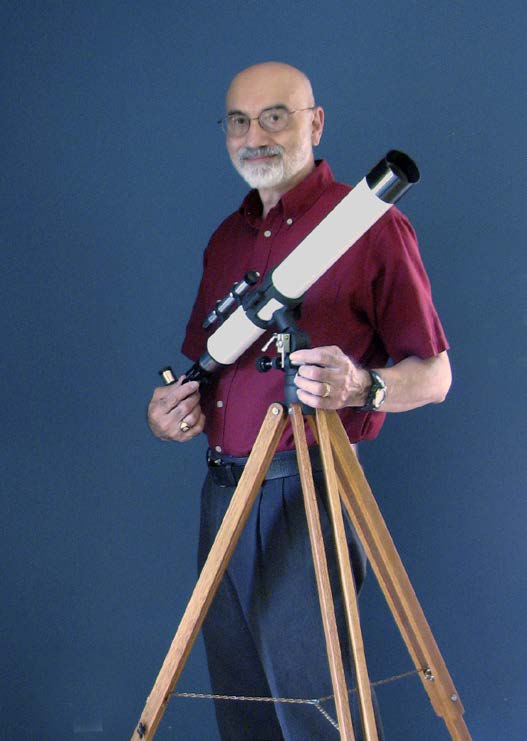
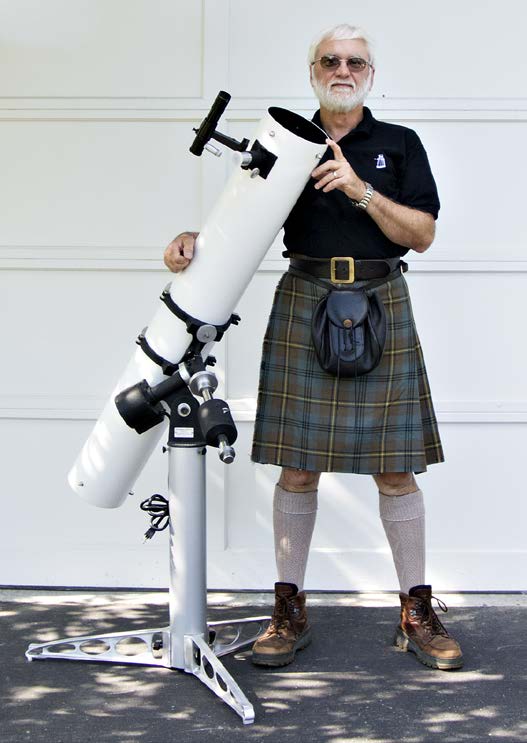
Written by Anthony Mallama. Edited by Bruce Krobusek. Proofread by Susan Krobusek.
Original drafting (1988) by Kim Aebi. Reproduced here with the original PDF available for download above.
Back cover — Halley's Comet orbit annotated with CVAS milestones from the 1963 founding through the projected 2061 return.